Popular Post

Sunday, May 1, 2011

Gulf oil spill one year later

Gulf oil spill one year later

What is the cost of spilling almost five million barrels of oil into the ocean? How do you measure that cost? In GDP reduction? In lives affected? In environmental impact? And how do you measure the cost when long-term effects are impossible to calculate yet, and when a significant portion of the spilled oil is still unaccounted for? One year since the Deepwater Horizon platform exploded, killing 11 workers, there are measurable effects, and many more unknowns. Collected here are pictures of the disaster, recent images of people affected by the spill, and views of the cleanup. Pictures 4 through 10 show areas of shoreline both immediately after the spill and the same area a year later. Click on the picture to see it change from the 2010 view to the present. This effect requires javascript to be enabled. -- Lane Turner (36 photos total)

An oil tar ball washes up on Fourchon Beach in Port Fourchon, La. April 13. Tar balls and oil are still in abundance on the Louisiana coast a year after the Deepwater Horizon oil spill. (Dave Martin/AP)


Fire boat response crews spray water on the blazing remnants of BP's Deepwater Horizon offshore oil rig on April 21, 2010. (US Coast Guard/AP)

An exhausted oil-covered brown pelican sits in a pool of oil along Queen Bess Island Pelican Rookery, three miles northeast of Grand Isle, La. on June 5, 2010. (Sean Gardner/Reuters)

Dead sea turtles wash up on the same Waveland, Miss. beach on May 5, 2010 and April 14, 2011. Endangered sea turtles and dolphins are still dying in high numbers in Mississippi, which continues to be impacted by tar balls and weathered oil.   [click image to see it fade]   (Joe Raedle/Getty Images) (Mario Tama/Getty Images)

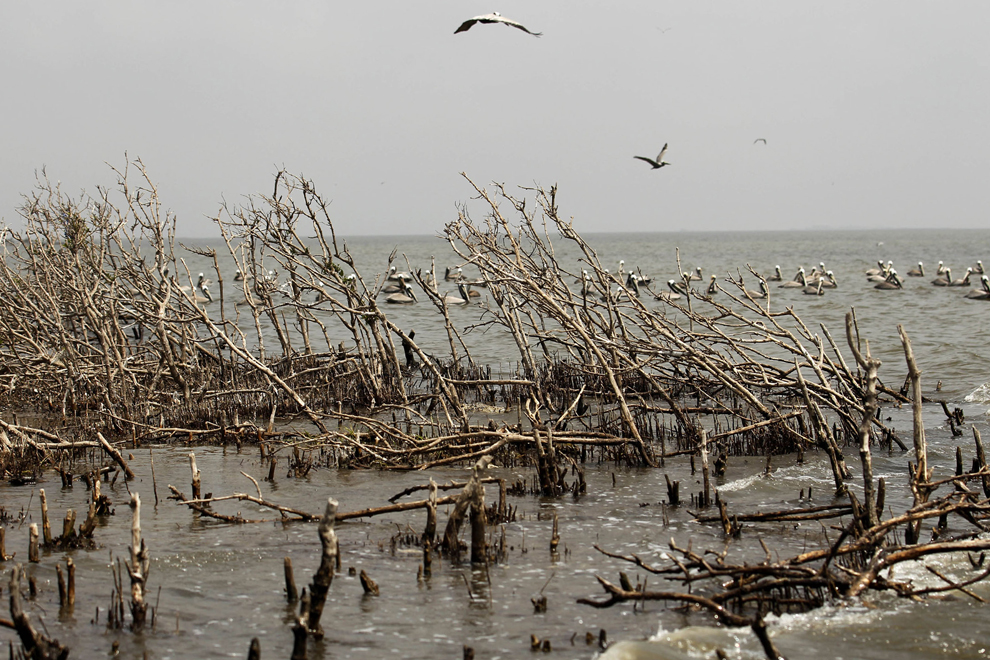
Oil-smeared pelican eggs are seen in a nest on Cat Island, La. on May 22, 2010, and on the same spot on April 8, 2011. The view shows the island significantly eroded and the marsh grass and mangrove trees that pelicans nest on decimated. The island was covered by oil and poorly maintained booms impacted it as well.   [click image to see it fade]   (Gerald Herbert/AP)

The same spot in Barataria Bay, La. on May 22, 2010, and April 8, 2011. In the first photograph, nesting pelicans land as oil washes ashore, and the second photograph shows the shoreline heavily eroded, with the lush marsh grass and mangrove trees mostly dead or dying.   [click image to see it fade]   (Gerald Herbert/AP)

Oil impacts pelicans and mangrove in these photographs, made on the same spot on Cat Island, La. on May 23, 2010, and April 8, 2011. The island is home to brown pelicans, terns, gulls, and roseate spoonbills.   [click image to see it fade]   (Gerald Herbert/AP)

A pelican and an egret, respectively, land on the same spot on Cat Island, La. on May 22, 2010, and April 13, 2011.   [click image to see it fade]   (Gerald Herbert/AP)

Normal and eroded shoreline with healthy and dead mangrove, respectively, are shown on the same spot on Cat Island, La. on May 22, 2010, and April 8, 2011.   [click image to see it fade]   (Gerald Herbert/AP)

Pelicans nest, and float offshore, respectively, in the same spot in photographs made on May 22, 2010, and April 8, 2011, on Cat Island, La.   [click image to see it fade]   (Gerald Herbert/AP)

Courtney Kemp, widow of Roy Wyatt Kemp, 27, who died in the Deepwater Horizon oil rig explosion, holds her daughters Kaylee, 3, and Madisson, 9 months, in Jonesville, La. November 11, 2010. Roy Wyatt Kemp was one of 11 workers killed in the disaster. (Gerald Herbert/AP)

Shrimper Sanh Dixie Le waits another day without shrimping, spending time on his boat "Quoc Viet", docked in Grand Isle, La., March 9. Le says after an average of eight hours of shrimping in the waters of the Gulf of Mexico he yields only three or four baskets of shrimp. He says BP offered him only $32,000, while other shrimpers have received $100,000. With gas prices high, he has to be selective about when he goes out. (Rod Lamkey, Jr./AFP/Getty Images)

Crab fisherman Thomas Barrios and his wife Alicia pose in the back of the family restaurant Alicia runs, Barrios Seafood Restaurant, in Golden Meadow, La. The family's income is completely dependent on the bounty of the seafood industry. They had to lay off workers and are struggling to stay afloat, as his crabbing enterprise has been halted, and the restaurant sales have been less than half since the Deepwater Horizon oil spill. (Gerald Herbert/AP)

Melvin Barnes, owner of Cuz's Seafood Restaurant and Market in Bay St. Louis, Miss., sits inside his empty restaurant on March 29. The oil spill closed waters that supplied much of the catch sold in the market. Customers stayed away from the restaurant, too, repulsed by the idea of eating Gulf seafood. Barnes sold off trucks to raise cash and is waiting for an interim compensation offer to arrive. (Gerald Herbert/AP)

Mayor Stan Wright pauses in Bayou La Batre, Ala. The small fishing town is struggling to survive following the Deepwater Horizon oil spill. (Dave Martin/AP)

Brad Mizell points to sores on his arm before attending a meeting for Gulf Coast residents who have health problems possibly related to the oil spill on April 18 in Bay St. Louis, Miss. Mizell worked on BP's Vessels of Opportunity program which hired local fishermen to help clean up the oil spill. He believes he was exposed to toxic dispersants and says he has since lost 50 pounds and developed a form of Rheumatoid arthritis and is now on 17 medications including steroids. More than 2 million gallons of the toxic dispersant Corexit were poured into the Gulf of Mexico following the spill. Corexit is banned in all of Europe because of its toxicity. (Mario Tama/Getty Images)

Lorrie Williams is hugged by oil pollution activist Riki Ott as Bud Waltman (left) pauses at a meeting for Gulf Coast residents who have health problems possibly related to the BP oil spill April 18 in Bay St. Louis, Miss. Williams has developed a litany of illnesses since the spill including lung polyps along with liver, thyroid and blood problems. Ott is a marine biologist and former commercial fisherwoman who was affected by the Alaska Exxon Valdez spill and is now advising Gulf Coast residents. (Mario Tama/Getty Images)

Fishermen and members of the community listen to Ken Feinberg, administrator of the BP claims fund, on March 28 at a public meeting in Mathews, La. (Julia Rendleman/The Houma Courier/AP)

Brenda Guidry of Larose, La. holds her head in frustration during a public meeting with BP claims fund administrator Ken Feinberg on March 28 in Mathews, La. (Julia Rendleman/The Houma Courier/AP)

Church members participate in an early morning prayer vigil to mark the one-year anniversary of the BP oil spill on April 20 in Orange Beach, Ala. (Mario Tama/Getty Images)

Institute for Marine Mammal Studies veterinary technician Wendy Hatchett prepares to take a skin sample from a dead bottlenose dolphin that was found decomposing on Ono Island, Ala. and brought for examination to Gulfport, Miss. Since January, 155 young or even fetal dolphins and small whales have washed up dead on Gulf beaches - more than four times the normal amount - according to the National Oceanic and Atmospheric Administration. A NOAA official called the oil spill "a possible cause" in the uptick in deaths. (Patrick Semansky/AP)

Tulane University population ecologist Jessica Henkel takes a blood sample from a Dunlin sandpiper on Fourchon Beach in Port Fourchon, La., as part of a research project that is looking for long-term, lethal effects from the oil spill on birds that stop along the Gulf Coast during their migration. “It's much easier to see a dead pelican on the beach” than it is to see more chronic population-wide effects, Henkel said. (Patrick Semansky/AP)

A dead endangered sea turtle is seen after it washed ashore and was flipped over by an activist April 16 in Pass Christian, Miss. The National Wildlife Federation reports that sea turtle strandings on the Gulf Coast were seven times the normal level in March. (Mario Tama/Getty Images)

A commercial fishing boat sits anchored before sunrise in Grand Isle, La. April 20. Grand Isle is a coastal community centered around fishing and tourism that was heavily impacted by the oil spill. (Patrick Semansky/AP)

A Louisiana National Guard helicopter flies over marshland on April 19 in route to Middle Ground in southern Louisiana. A year after the oil spill coated Gulf Coast marshes and beaches, BP claims that most of the oil has been removed. Louisiana Wildlife and Fisheries says, however, that much of the cleaning has been superficial, as the oil has seeped into the soil, killing marshes and further eroding the state's damaged delta ecosystem. (John Moore/Getty Images)

Sunbathers stroll the beach as oil spill cleanup workers search for tar balls in Gulf Shores, Ala. April 20. Tar balls continue to wash ashore a year after the oil spill. (Dave Martin/AP)

Robert Barham of the Louisiana Wildlife and Fisheries office digs up oiled sand on a beach on April 19 at South Pass in southern Louisiana. BP claims that most of the oil has been removed. Barham says, however, that much of the coastal cleaning has been superficial, as the oil has seeped into the soil, killing marshes and further eroding the state's damaged Mississippi Delta ecosystem. (John Moore/Getty Images)

A Louisiana wildlife official displays oil from a marsh on April 19, 2011 in Middle Ground, La. (John Moore/Getty Images)

Workers clean a section of shoreline heavily damaged by the oil spill at the mouth of the Mississippi River where it meets the Gulf of Mexico. (Gerald Herbert/AP)

A crew checks on propane-powered sound cannons used to keep birds from nesting in oil-soaked marsh grasses in Bay Jimmy, one of the hardest hit areas of coastal Louisiana on April 7. (Mira Oberman/AFP/Getty Images)

Workers use a crane to remove clumps of shoreline heavily damaged by the Deepwater Horizon oil spill in Bay Jimmy in Plaquemines Parish, La. on April 8. (Gerald Herbert/AP)

An oil cleanup site operates on a small island April 13 in Barataria Bay, La. (Mario Tama/Getty Images)

A woman walks along the beach as waves wash up from the Gulf of Mexico April 13 in Grand Isle, La. Residents report that oil still washes up onto the beach after storms. (Mario Tama/Getty Images)

A group of scientists from the Manomet (Mass.) Center for Conservation Sciences spent months trying to catch, radio tag, and track the tiny oystercatcher, a rare shore bird, in order to help calculate the costs of the oil spill in the Gulf of Mexico. Shiloh Shulte, coordinator of the American Oystercatcher Campaign, used an antenna to listen for a signal indicating life or death for a banded bird, while field technician Laura Koloski and Stephen Brown, director of Shore Bird Science, worked nearby in Grand Isle, La. on November 8, 2010. (Suzanne Kreiter/Globe Staff)

On East Grand Terre Island, La., a pair of Oystercatchers walk on the beach in front of clean-up crews November 8, 2010. (Suzanne Kreiter/Globe staff)

A crane stands on a beach chair at dawn on the one-year anniversary of the oil spill on April 20 in Orange Beach, Ala. (Mario Tama/Getty Images)

Japan's crisis: one month later

Japan is just in the beginning of the long term recovery effort from the earthquake that struck off northeastern Japan on March 11. The crisis alert level from the damage to the Fukushima Nuclear Power Plant has now been raised to the highest level of impact, the same as the Chernobyl Russia incident 25 years ago. Searchers continue to look for the dead, displaced Japanese live in shelters, protests continue over use of nuclear power, Japan's economic engine may be disrupted, the massive cleanup of debris is just underway, aftershocks are feared and many continue to mourn those who were lost. The photos collected here are from one month to the day of the quake and beyond. -- Lloyd Young (36 photos total)

Buddhist monks, Japan Self-Defense Force personnel, firefighters,
and other relief workers observed a moment of silence on "Hiyori Yama," or Weather Hill, in Natori, Miyagi prefecture, on April 11, 2011, exactly one month after the devastating earthquake and tsunami hit northeastern Japan. Local fishermen used to climb the manmade hump and decide whether it was safe to fish. (Koichi Nakamura,Yomiuri Shimbun/Associated Press)


2
Elementary school children crouched under their desks at their school in Onagawa, Miyagi prefecture, on April 12, 2011, as a powerful aftershock hit northern Japan. Japan added to the evacuation zone around the stricken nuclear plant, as a powerful aftershock rattled the nation a month after its biggest recorded earthquake wrought devastation. (AFP/Getty Images)

3
Mud and trees covered part of a road after a landslide caused by a magnitude 7.0 earthquake on April 11, 2011, in Iwaki, Fukushima prefecture, Japan. (Kyodo News/Associated Press)

4
An evacuee sat in a partitioned "room" at a gymnasium converted into a shelter in Kamaishi, Iwate prefecture, on April 12, 2011, a month after the March 11 earthquake and tsunami hit the northeastern coast of Japan. (Kazuhiro Nogi/AFP/Getty Images

5
Rui Sato, 2, showed off his key chain while playing with a Japan Red Cross member at an evacuation center in Fukushima, northeastern Japan, on April 11, 2011. (Hiro Komae/Associated Press)

6
Teru Sutou, 8, and his brother Ren, 9, ate a distributed hot stew and rice at a parking lot in Minamisanriku, Miyagi prefecture, on April 12, 2011. Japan's Prime Minister Naoto Kan said that the Fukushima nuclear plant is gradually stabilizing and that the amount of radiation being released is falling. (Yasuyoshi Chiba/AFP/Getty Images)

7
A volunteer cleaned a family photo that was washed by the March 11 earthquake and tsunami as baby photos were placed to dry at a volunteer center in Ofunato, Iwate prefecture, April 12, 2011. (Toru Hanai/Reuters)

8
Japanese police officers climbed up a slope in Minamisanriku, Miyagi prefecture, after receiving a tsunami warning following a powerful tremor, one of hundreds of aftershocks stemming from the massive earthquake a month ago. (Yasuyoshi Chiba/AFP/Getty Images)

9
Fisherman Koichi Sasaki looked for his wedding ring, which was lost a month earlier during the March 11 earthquake and tsunami, at a damaged area in Ofunato, Iwate prefecture. (Toru Hanai/Reuters)

10
Shoppers looked for vegetables during a sale of produce from the city of Iwaki in Fukushima prefecture on April 12, 2011. The government is trying to support farmers in Fukushima who are hurting from dropped sales due to rumors of the spread of radiation from the troubled nuclear power plant. (Yasuyoshi Chiba/AFP/Getty Images)

11
Kiyoi Oikawa, 74, collected water from a well with a recycled bucket to wash her clothes from her destroyed home in Minamisanriku on April 12, 2011. Japan's Prime Minister Naoto Kan said that the Fukushima nuclear plant is gradually stabilizing and that the amount of radiation being released is falling. (Yasuyoshi Chiba/AFP/Getty Images)

12
A Japanese man cleaned up his workshop in the area devastated by the March 11 earthquake and tsunami in the town of Minamisanriku. (Sergey Ponomarev/Associated Press)

13
Japan's Prime Minister Naoto Kan spoke at a news conference at his official residence in Tokyo on April 12, 2011. China said on Tuesday it was still concerned about Japan's nuclear calamity, a disaster Japan put on a par with the world's worst nuclear accident, Chernobyl. (Yuriko Nakao/Reuters)

14
Japan's Nuclear Safety Agency official Hidehiko Nishiyama spoke during a news conference on the announcement on nuclear accident severity level in Tokyo on April 12, 2011. Japan raised the severity of its nuclear disaster to seven, the highest level, on Tuesday, putting it on a par with the world's worst disaster nuclear accident at Chernobyl after another major aftershock rattled the quake-ravaged east. (Yuriko Nakao/Reuters)

15
Fire could be seen in the sampling building near a water drain of TEPCO Fukushima No.1 (Dai-Ichi) nuclear power plant in the town of Okuma in Fukushima prefecture. The fire broke out at the stricken nuclear plant in the morning of April 12, 2011, but was soon extinguished. (TEPCO/AFP/Getty Images)

16
An employee inspected auto parts on the production line of Iwaki Diecast Co.'s plant in Yamamoto, Miyagi prefecture, Japan. Toyota Motor Corp. told US dealers that assembly disruptions triggered by last month's record earthquake and tsunami in Japan may thin supplies of vehicles into the third quarter. (Tomohiro Ohsumi/Bloomberg)

17
A man looked at the closing price of Japan's Nikkei share average (top center) displayed along with major indices outside a brokerage in Tokyo. The Nikkei average dropped for a second straight day April 12 on growing worries that the impact of the March 11 earthquake may be more severe than hoped and as Japan put its nuclear crisis on par with Chernobyl. (Yuriko Nakao/Reuters)

18
A man looked for his personal belongings at a collection center for items found in the rubble of an area devastated by the March 11 earthquake and tsunami, in Natori, northern Japan. (Kim Kyung-Hoon/Reuters)

19
Japan Self-Defense Force members searched for victims in debris caused by the March 11 tsunami in Natori, Miyagi Prefecture, Japan, on April 12, 2011. (Lee Jin-man/Associated Press)

20
During an event in Tokyo to promote safety of agricultural products, a man used a radiation detector to measure the level in strawberries produced in Iwaki City, Fukushima prefecture. (Koji Sasahara/Associated Press)

21
A man was tested for contamination in Koriyama, Fukushima prefecture, northern Japan, on April 12, 2011. (Kim Kyung-Hoon/Reuters)

22
A Buddhist monk prayed for earthquake victims at a burial site in Higashimatsushima, Miyagi prefecture, one month after the earthquake and tsunami struck northern Japan. Across the country people stood in silence at 2:46 p.m. local time on April 11 to remember the thousands killed. (Athit Perawongmetha/Getty Images)

23
Greenpeace activists and other environmentalists lit candles amid hundreds of paper cranes at the Heroes' Monument at suburban Quezon city, Philippines, on April 11 in solidarity to the Japanese disaster victims. The protesters are calling for an end to nuclear power around the world. (Bullit Marquez/Associated Press)

24
People wearing masks and raincoats took part in an antiradioactivity rally in Seoul, South Korea, to urge the government to quickly release information about "radioactive rain" and other risks on April 12, 2011. China and South Korea have been critical of the crippled nuclear plant operator's decision to pump radioactive water into the sea, a process it has now stopped. (Jo Yong-Ha/Reuters)

25
Family members looked at their collapsed house in Kesennuma, Miyagi prefecture, on April 11, 2011, a month after the earthquake and tsunami. (Kazuhiro Nogi/AFP/Getty Images)

26
Japanese Self-Defense Forces cleaned the rooms at the Okawa elementary school in Ishinomaki, Miyagi prefecture. Japan said it was to widen the evacuation area around a crippled nuclear plant to include territory outside the current 12-mile exclusion zone. (Yasuyoshi Chiba/AFP/Getty Images)

27
A Japanese man rode a bicycle along a flooded street at an area devastated by the March 11 earthquake and tsunami in the port town of Kesennuma, Miyagi prefecture, Japan. (Sergey Ponomarev/Associated Press)

28
A man looked at newspaper reports about the earthquake and tsunami on display at the Miyagi Prefectural Government building in Sendai, northeastern Japan. (Vincent Yu/Associated Press)

29
Survivors prayed at the wreckage of a house in Natori, Miyagi prefecture, northern Japan. (Lee Jin-man/Associated Press)

30
Abandoned flowers wilted within the exclusion zone of Fukushima Nuclear Power Plant in Futaba Town, Fukushima prefecture, Japan. (Athit Perawongmetha/Getty Images)

31
A deserted street in Futaba inside the exclusion zone around from Fukushima Nuclear Power Plant. (Athit Perawongmetha/Getty Images)

32
Debris was strewn in Namie, within the exclusion zone around Fukushima Nuclear Power Plant. Japan's Nuclear and Industrial Safety Agency raised the crisis alert level from level five to seven, the highest level on the scale. (Athit Perawongmetha/Getty Images)

33
Members of the Japan's Self-Defense Force cleaned up debris on April 11 in an area destroyed a month ago by the tsunami in Natori, Miyagi prefecture, northern Japan. (Vincent Yu/Associated Press)

34
A month after the tsunami devastation, 2-year-old Ayaka and family members prayed for her missing grandmother and great-grandmother at a vacant lot where they lived in Ishinomaki, Miyagi prefecture. (Yasuyoshi Chiba/AFP/Getty Images)

35
Masataka Shimizu (center), president of Tokyo Electric Power Co. , flanked by vice presidents Takashi Fujimoto and Sakae Muto, bowed during a news conference at the company's headquarters in Tokyo on April 13. The president defended the utility's response to the worst nuclear crisis since Chernobyl and pledged pay cuts as workers struggle to control radiation leaks from a crippled atomic power station. (Kiyoshi Ota/Bloomberg)

36
The sun set on April 13, 2011, over debris still piled up nearly five weeks after the earthquake and tsunami disaster devastated the city of Ishinomaki in Miyagi prefecture. The impact of Japan's earthquake and nuclear crisis rippled through the economy as the government downgraded its outlook and Toyota announced more temporary plant shutdowns overseas. (Yasuyoshi Chiba/AFP/Getty Images)